Cloth Notes · 2026.06 · 20 min read
How to Read a Cloth
A guide to reading cloth beyond the Super number: fibre, weight, worsted and woollen structure, the trade behind the loom, and the provenance a specification cannot hold.
Share / 分享
Ready
From a number to a provenance
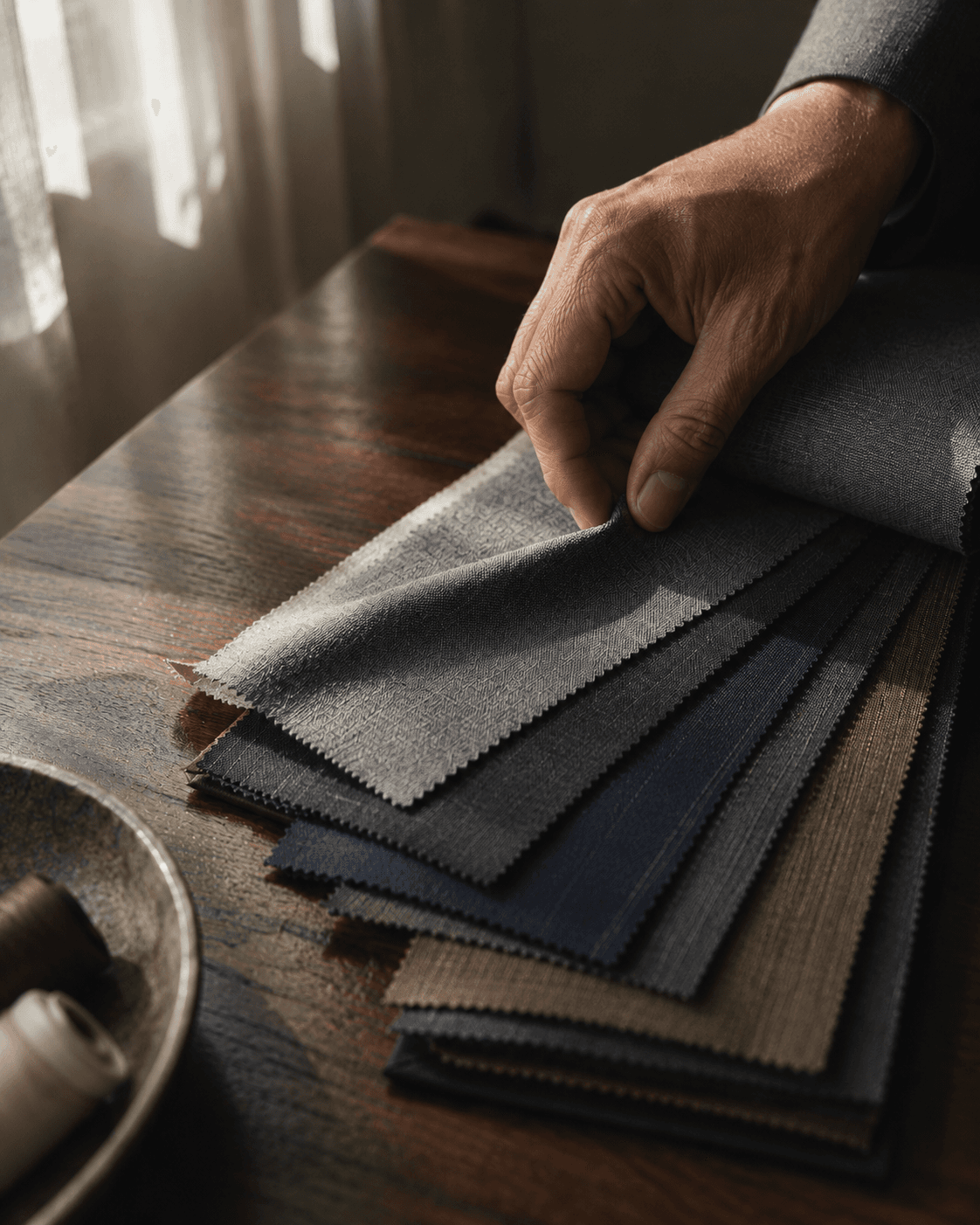
Your tailor turns the pages of the bunch, and your finger settles on a swatch. At this moment you almost certainly have a single word in your head: the Super number.
It is a word we are taught in a way that makes choosing cloth seem simple — higher is better, higher is finer, higher is grander. Super 120, 150, 180: a row of price tags, arranging every cloth on one straight line from low to high, so that all you appear to be doing is finding the point on that line your budget can reach.
But the number is not a conclusion. It is a door.
What I want to do here is open the rooms behind that door, one at a time — so that you can pick up a length of cloth, hold it against your own life, and judge it for yourself, instead of handing that judgement to a number on a swatch card.
A Number
In fairness, the Super count is not a swindle. It does measure something real.
It measures the fineness of the wool fibre, usually in microns: the higher the number, the finer the fibre, and a strand of Super 180 is far thinner than a human hair. Finer fibre spins into softer, more lustrous yarn, and it falls with more fluidity. All of this you can feel under your hand, and none of it is nothing.
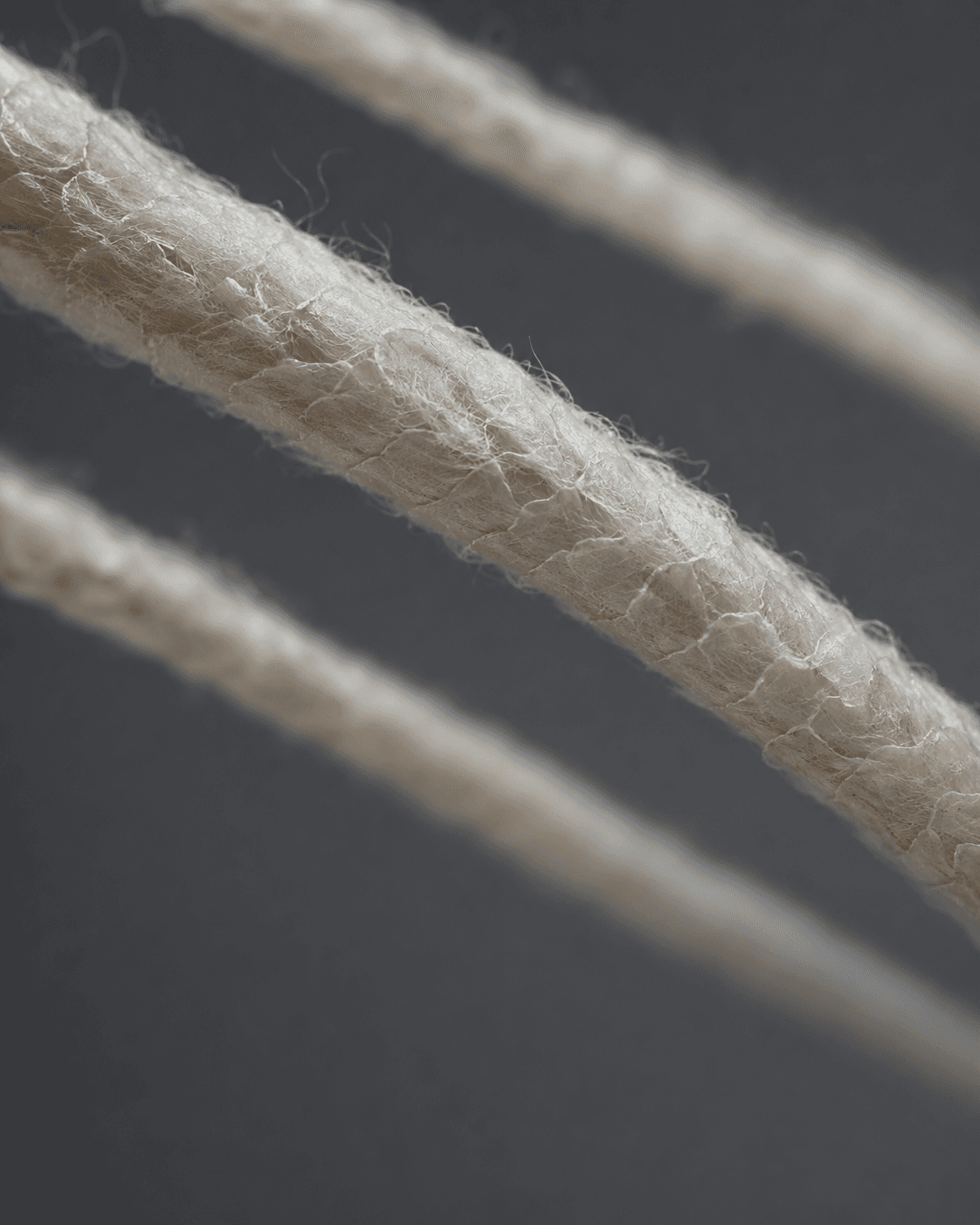
The trouble is the cost. The finer the fibre, the more fragile it is. Made into a suit you wear most days, a cloth much above Super 150 can start to pill and shine at the elbows and knees within a season or two — sooner than the price would lead you to expect.
The mills know this better than anyone. Vitale Barberis Canonico weaves a cloth called Revenge from pure merino at Super 150 — around sixteen microns, not far off cashmere. Precisely because the material is so fine, the mill doesn't leave it in a simple plain weave; it twists multiple plies together in both warp and weft, bracing a yarn that can't quite stand on its own. Its grander Greenhills uses Super 180 wool of 14.5 microns at just 230 grams a metre — extraordinarily soft and fluid — and there too the mill has to weave it compactly, or it wouldn't hold a garment up at all. The skill is going, in other words, into shoring up the very fineness you are paying a premium for.
Fineness and durability tend to pull against each other.
For most wardrobes the everyday workhorses still sit somewhere around Super 100 to 120: fine enough to look like something, not so fine that daily wear undoes them inside a year.
So the useful question isn't how fine? but how hard you actually mean to wear the thing. If it's the suit you reach for five mornings a week, climbing the Super scale is a slow way to throw money away. If it's the suit you wear a few times a year, by all means indulge — there's no penalty.
The same number can be right and wrong at once, depending on what you're asking the cloth to do.
The Vanished Weight
There's a second thing the number won't tell you, and most people never think to look for it: weight.
The chase for fineness has always been tied up with a chase for lightness — finer fibre makes lighter cloth. Over the past few decades suiting has fallen from thirteen or sixteen ounces down to seven or eight, rebranded "four-season" and sold to customers who spend their days in air-conditioning and on planes.
What you lose is drape. A very light cloth has little structure of its own; it tends to hang flat and slack, and it gives out sooner than you'd hope. Lightness sounds like pure gain, but a cloth needs a certain weight to fall properly, and the lightest ones simply don't.
To see what weight is actually for, it helps to handle a cloth that has it.
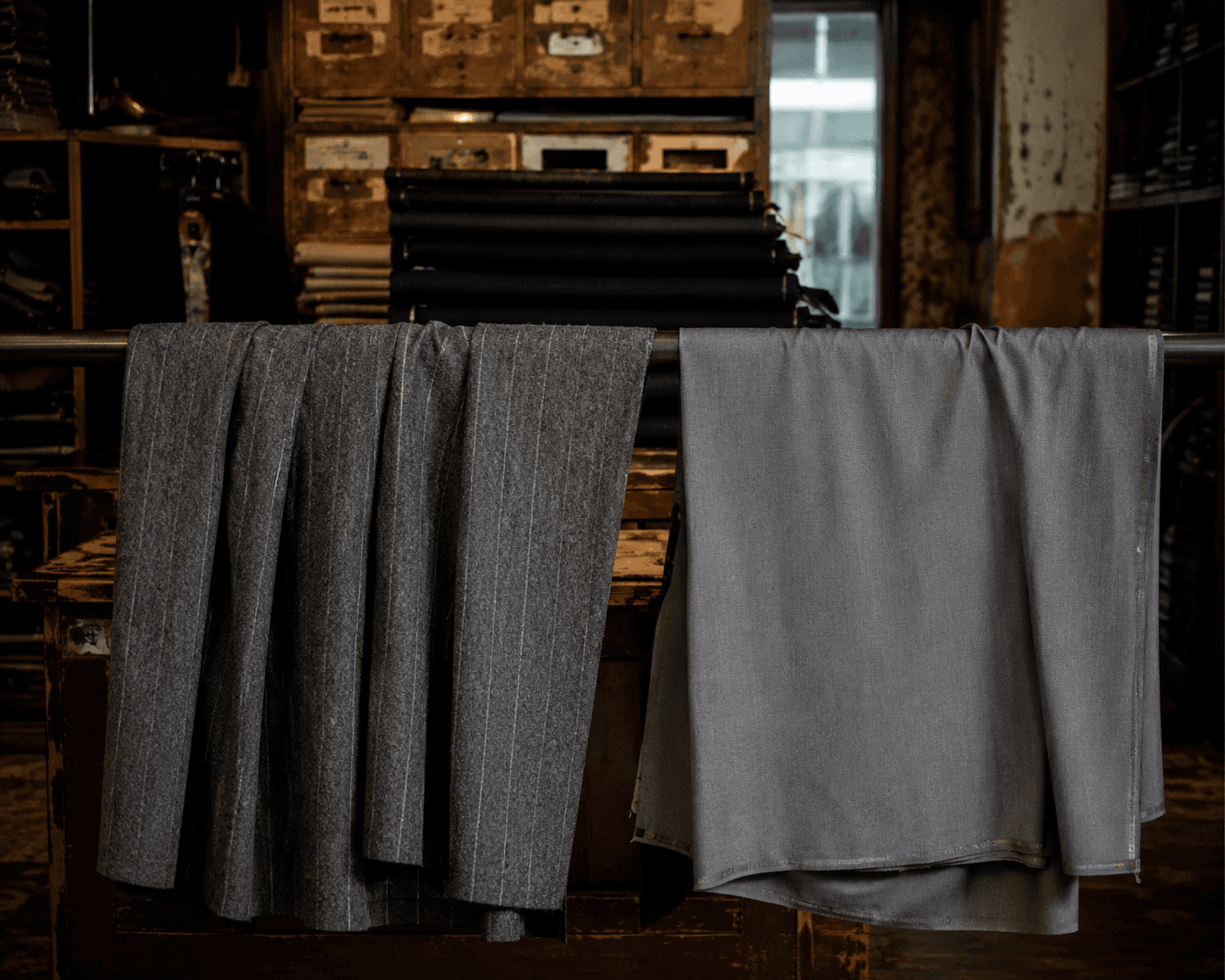
Fox Brothers, an old mill in Wellington, in the southwest of England, is generally credited with inventing flannel for tailoring; it held the trademark on the word "Flannel" itself until the 1950s. In the first year of the Great War it took the single largest textile order of the conflict — 825 miles of khaki — a cloth Fox itself had introduced in 1901. In 1936 Churchill chose Fox flannel, cut by Henry Poole of Savile Row, for what became one of the most photographed suits of the century.
But the telling thing about Fox flannel isn't the names; it's how the cloth ages. A fourteen-ounce chalkstripe starts out stiff, with a faint chalkiness to the hand. As you wear it, the fibres loosen and the whole thing softens and settles — without losing its structure.
That is the real argument for weight. A cloth with some substance to it doesn't just survive wear; it gets better for it, the drape settling in as you use it. The very light cloths have nowhere to go but down.
Weight buys you structure and costs you ease, roughly speaking. A heavier cloth drapes, holds its line, gives a suit some presence — but it's warm, less convenient, fussier about the season. A light cloth is comfortable and portable, and goes slack, and can't really carry a room.
So: do you want this garment's presence, or its invisibility? A suit meant to hold a room and a coat meant to follow you around the world sit at opposite ends of the same axis. Neither is better; they're answering different questions.
Worsted and Woollen
Once you start noticing weight, you need some vocabulary, because "heavy" and "light" don't get you very far.
Of everything there is to learn about cloth, the one distinction worth committing to memory is this: worsted and woollen.
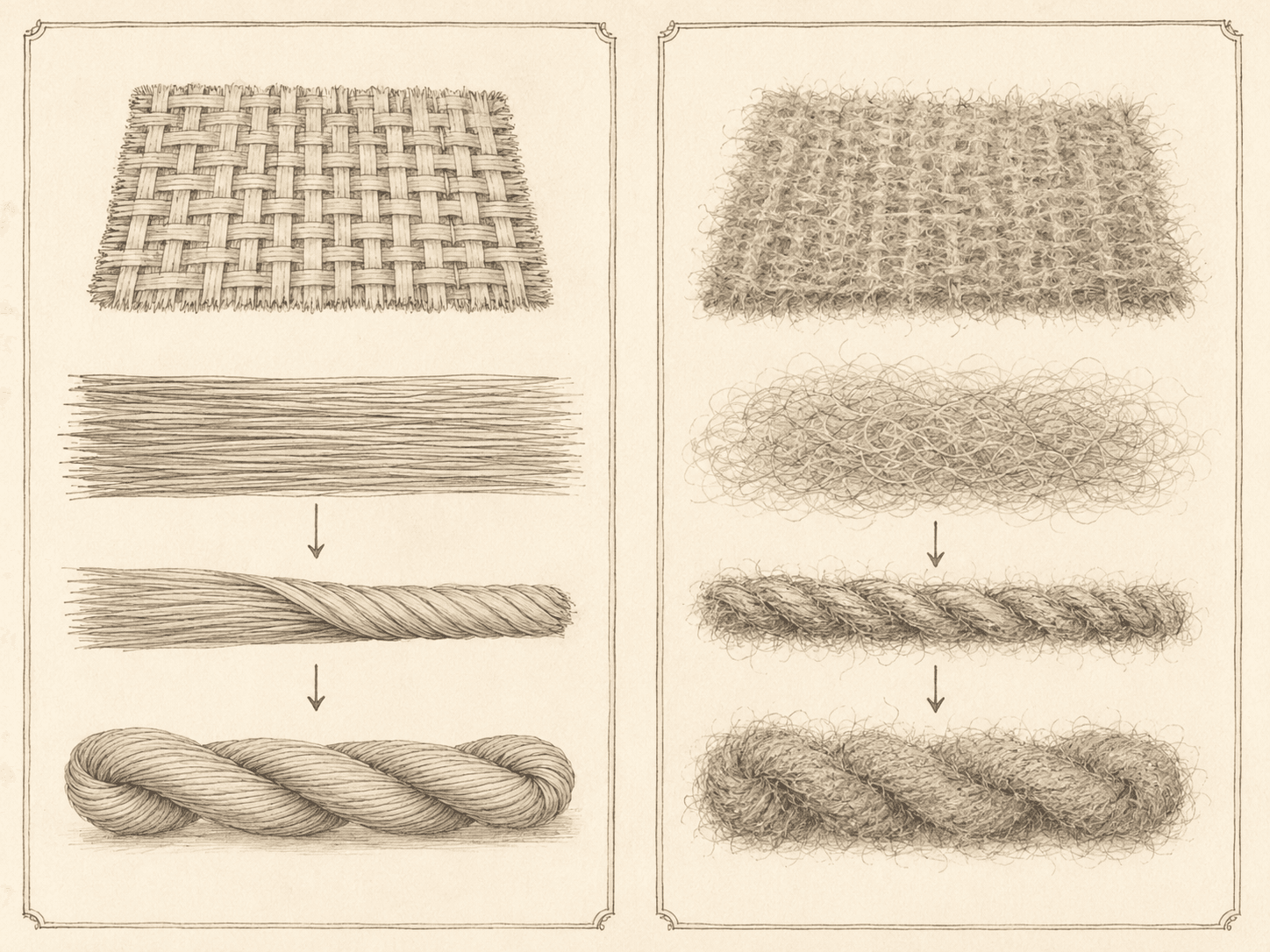
Worsted is wool combed straight before it's spun — smooth, crisp, able to take a sharp crease, formal by default; most of the suiting in your wardrobe is worsted. Woollen is wool left lofty, not combed straight — soft, warm, with a faint nap on the surface; flannel and tweed are woollen. The Fox flannel from a moment ago is woollen at its best.
These aren't two sealed boxes — a single cloth can lean either way. Vitale Barberis Canonico makes its flannel in both a worsted and a carded version. It's a technical axis, and it has nothing to do with the name on the swatch.
What's useful here isn't the terminology for its own sake. It's that you can finally say what you want — sharp or soft, dry or warm — instead of pointing at "the expensive one."
And the question this time isn't really technical at all: do you want the cloth to read sharp, or soft? That's less a specification than a question of how you'd like to come across, and where.
This pair predicts a cloth's behaviour better than any Super count does. Take summer. People reach for linen and find it creased within ten minutes, looking as though they've just got up from a nap; the more useful answer is usually a high-twist worsted — something like Fresco, open in weave, breathable, and yet crisp enough to resist creasing. What keeps it cool and presentable isn't a number but a combination: worsted, high twist, open weave. That's the kind of thing someone who actually knows cloth will tell you — weave and twist, rather than a figure.
Whose Loom
The next thing worth knowing sits behind the cloth rather than in it — and it's the largest open secret in the trade.
In the English system, the merchant and the mill are two different things. Many of the grand names on the bunch never touch a loom: they design the patterns, hold the stock, and sell to tailors, and that's all. The weaving is done by another set of firms whose names you've probably never heard.
This isn't conjecture. Walk into a mill like Pennine and you'll see Dormeuil cloth and Dugdale cloth coming off the same looms; the weaving is identical, and only the yarn and the set of the weave differ. The base bunches of Lesser and of Smith's are nearly the same, because the weaving is shared between them. Some merchants are another step removed: behind Dormeuil sits a separate company, Minova, which sources the yarn and arranges production, and is routinely mistaken for a mill.
The largest name behind all of it is VBC — Vitale Barberis Canonico. Founded in 1663, it's the oldest recorded mill still working anywhere; it turns out as much as eight million metres of cloth a year, gets through four million kilograms of wool, and designs something like five thousand fabrics annually. It keeps a small flock of its own sheep in Australia and combs, dyes, spins, weaves and finishes everything in-house. Roughly half its cloth it sells under its own name; the rest goes out under others' — Smith's, Wain Shiell, Dormeuil. As the trade joke has it, it supplies everyone.
The odd part is that VBC is often thought less "grand" than Zegna or Dormeuil — only because its range runs so wide, from the cheap to the sumptuous. The same mill's cloth, under different names, ends up sorted into different price brackets.
None of this is an exposé, and it isn't licence to sneer at brands. It's a sharper way of seeing, that's all: past the label, to where the cloth was actually made.
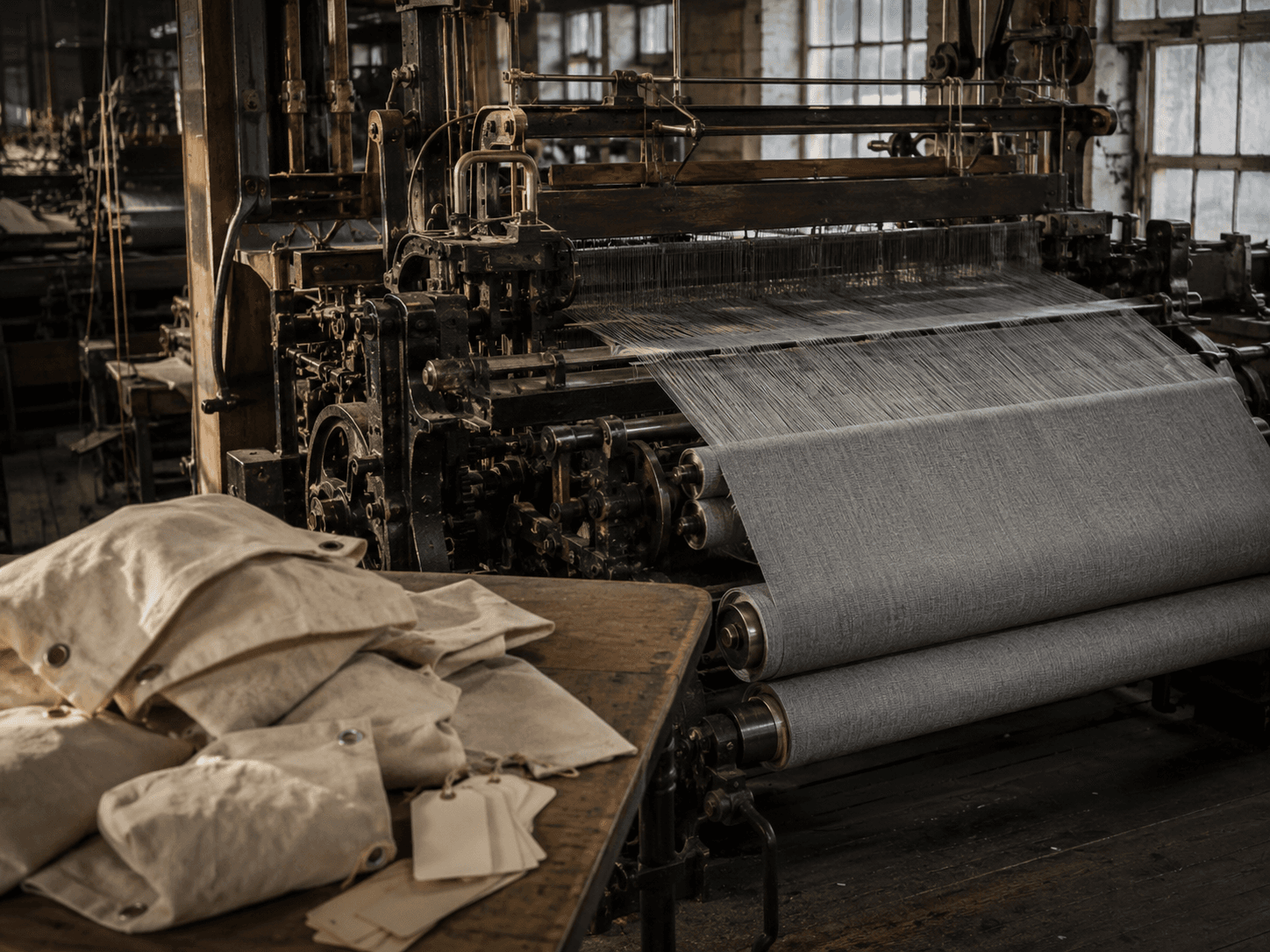
And the merchant isn't a parasite. Laying down a single complete bunch can cost somewhere between a hundred and two hundred thousand pounds; the merchant carries the risk of the design, of betting on a pattern, of holding stock against slow returns. That's real work. The only thing worth keeping straight is which part of the price is cloth and which part is design and name.
It does, though, puncture a myth the luxury magazines are fond of: that owning every step of production is some great virtue in itself. VBC is vertically integrated to the hilt, and the English division of labour — Pennine weaves, Johnson's finishes, Dugdale's sells — turns out a final cloth that's scarcely different. Integration is a useful story, but not, by itself, a guarantee of anything.
There are counter-examples, naturally. Fox Brothers is one of the few mills that still weaves its cloth entirely in England and sells under its own name — the inverse of the merchant model. Both ways of working are sound.
So you're trading name against substance, in the end. How much of what you paid went to the cloth, and how much to the name — and do you mind? There's nothing wrong with paying for a name; the mistake is only to confuse the name with the cloth.
So far this has all been about the cloth, and then about who wove it. There's one more layer, and it's the one that doesn't behave like the others: where the cloth comes from, in the largest sense — its provenance.
Provenance
The four considerations so far can each be weighed against a need — durability, occasion, temperament, budget. They're useful. They help you choose the right cloth for yourself.
This last one won't be weighed.
Provenance solves no practical problem. Gambiered Canton gauze won't make a suit wear longer; Harris Tweed won't make you better dressed. It answers a different question: once you've settled every practical dimension of a cloth, do you also want it to carry a history that no specification can account for?
Two Western cloths put the matter plainly.
Solaro
Solaro was devised in 1907 by Louis Westenra Sambon, a physician who specialised in tropical disease. It was meant as a technical fabric, to fend off ultraviolet light, and British troops in the tropical colonies took to it at once: they lined their helmets with the red side and made their uniforms from the beige. Sambon was sure the red warp running beneath the surface would reflect the sun's harmful rays away.
It did almost nothing of the kind. A later American study reached a flat verdict — the cloth was "extremely uncomfortable and probably detrimental to health."
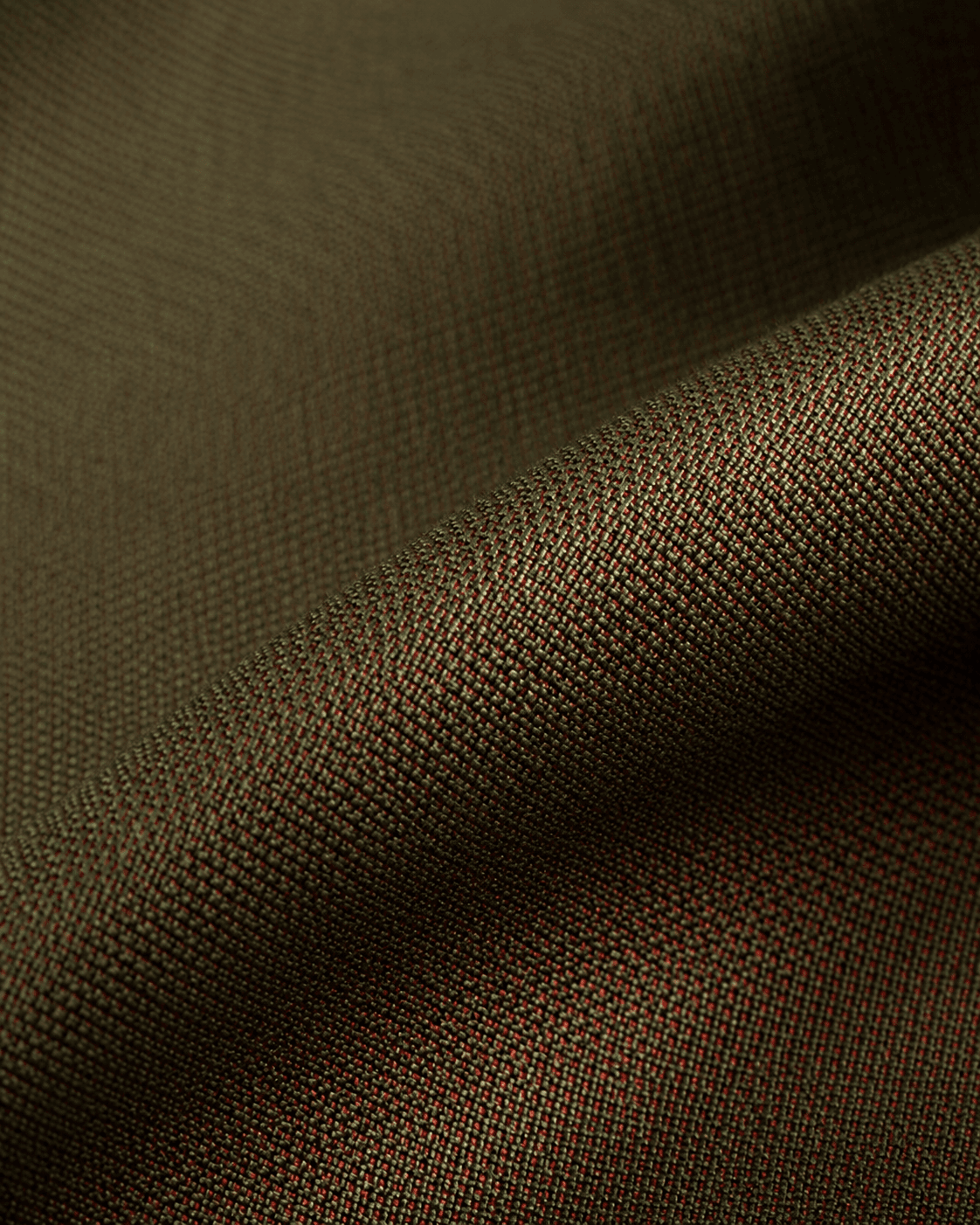
And it survived anyway. Today only the London merchant Smith Woollens, now part of Harrisons, makes the real thing: an olive cloth woven with red yarn on the underside, which surfaces and recedes with the light and the angle. Its appeal has nothing to do with how it performs, which is badly. The appeal is the story — absurd, and entirely true.
Escorial
This is among the rarest wools there is, taken from a small purebred sheep descended directly from the flock once kept by the king of Spain.
How rare? There are perhaps a hundred and seventy million merino sheep in the world, a hundred and fifty million cashmere goats, a million vicuña — and fifty thousand Escorial. Its survival runs across centuries. During the Napoleonic wars the breed came close to extinction in Spain, through wartime neglect and the pressing need for meat, and was saved largely because a Scotswoman, Eliza Furlong, carried a hundred and twenty of the sheep to Australia on a voyage of two hundred and fifty days.
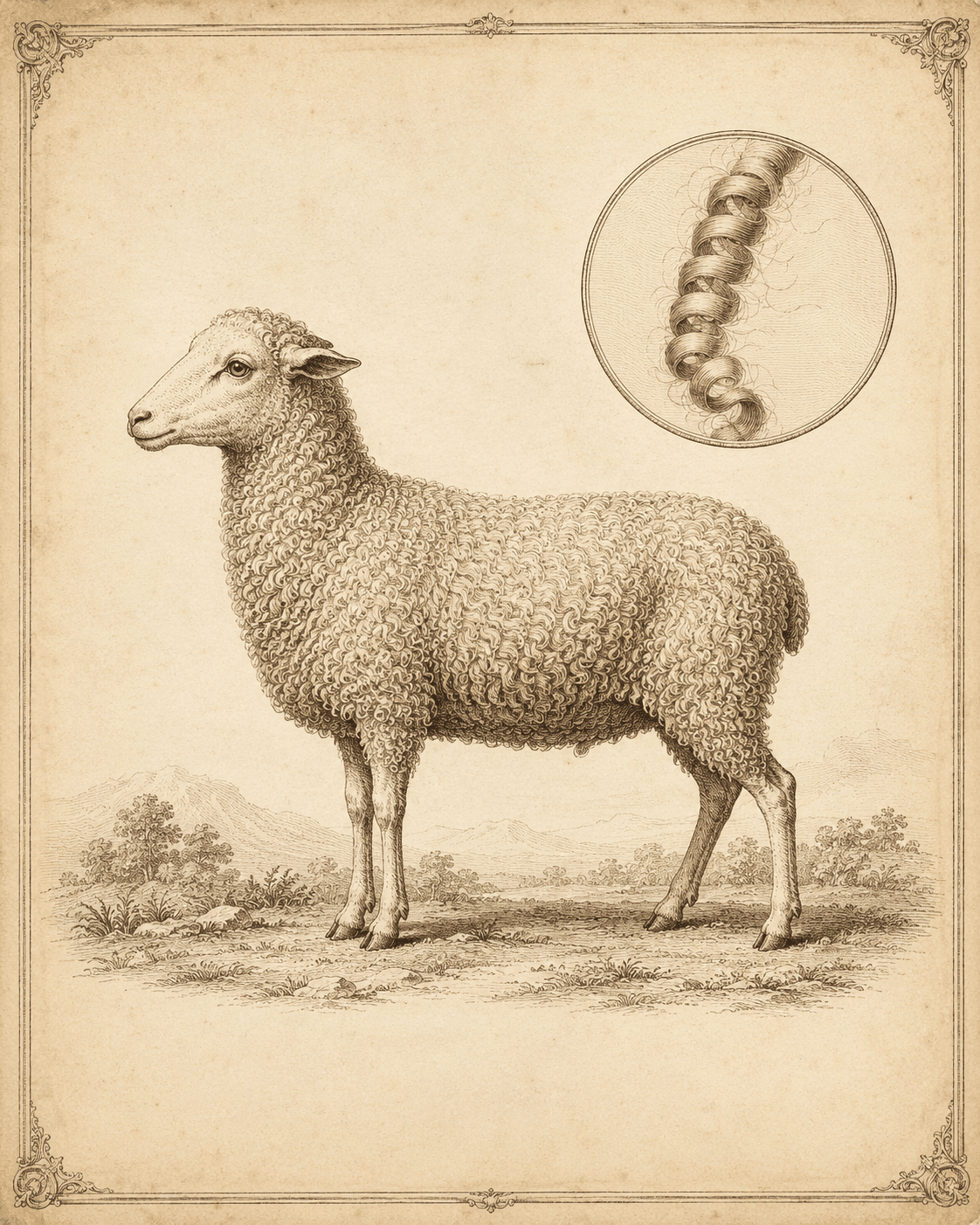
Even its most concrete physical virtue grows out of that history. Unlike any other natural fibre, Escorial has an unusual crimp at the core of the strand — something like a coiled spring — and it's that hidden spring that gives the cloth its drape, its recovery, its resistance to creasing. You can't quite say whether the quality comes from the craft or from seven centuries of royal blood.
Two faces
Now bring the eye back to the last pair. At first they look like opposites.
Harris Tweed was made to defy time. Thick, coarse, napped, growing stronger the more it's worn, it was woven for the gales and cold rain of the Outer Hebrides, and its ideal is endurance — the same self after thirty years. The telling thing is its legal definition. Britain protects the cloth by statute, and what the statute specifies isn't any measure of performance but a place and a people: it must be handwoven by the islanders of the Outer Hebrides, in their own homes. The law is protecting a way of life as much as a fabric.
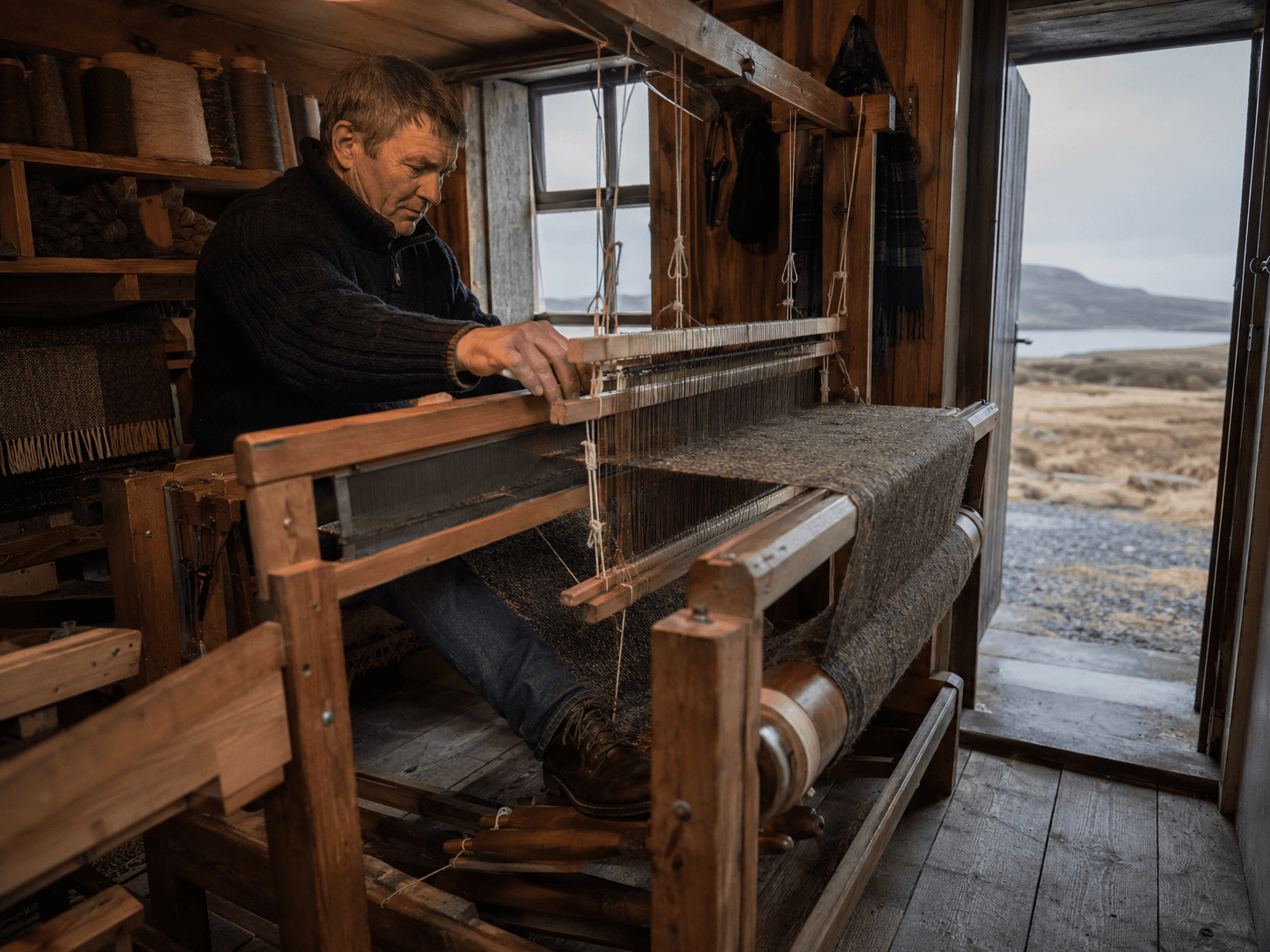
Gambiered Canton gauze was made to harbour time. It's thin, brittle, cool to the touch, and wants careful handling. It doesn't resist wear so much as absorb it: worn long enough, the surface crazes and takes on a patina, so the cloth ends up holding a record of how it was used.
Its name is itself a small piece of history. Walking, the cloth gives off a soft sha-sha rustle, and so it was first called xiangyunsha in the sense of "rustling cloud gauze"; later a slippage of sound swapped the word for "rustling" for a near-homophone meaning "fragrant," and it's been "fragrant cloud gauze" ever since. A maker pulls a length free and it sounds in the air — you can hear how stiff and substantial it is.
The colour comes from an actual chemical reaction: the polyphenols and tannins in the juice of the yam (Dioscorea cirrhosa) meet the ferric ions in river mud and throw down a black precipitate that sets into the surface of the silk. The result is two-faced — black on the front, tan-brown on the reverse.
And the process behind it is slow, weather-dependent and physically repetitive: soak the silk in the yam juice, spread it on the grass to dry under the sun, coat it with river mud, lay it out again, lift it, and repeat, over and over, across the better part of a year. A length of raw white gauze is said to pass through "three washings, nine boilings, eighteen sunnings" before it turns that deep, warm black.
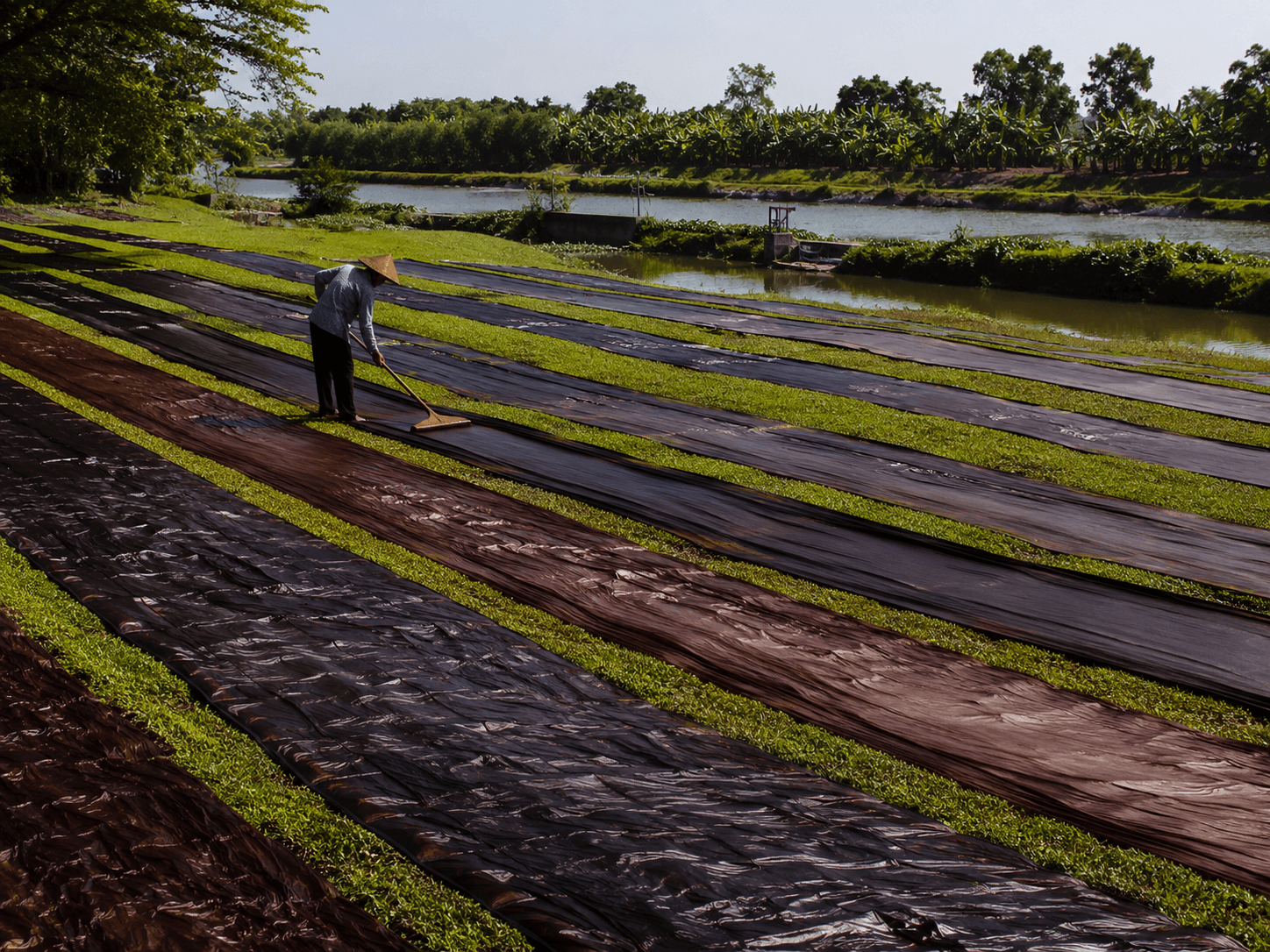
The strangest constraint is geographic. The mud has to carry ferrous sulphide within a fairly narrow band — roughly 0.6 to 0.9 — and in practice that mud has only ever been found in the Pearl River Delta. The orange tree, the old saying goes, bears sweet fruit south of the river and bitter fruit to the north. In the 1990s a Japanese textile engineer went to Shunde to learn the craft and take it home whole; he couldn't reproduce it.
For all these reasons the craft nearly died out. Wholly handmade, fiercely involved, and at the mercy of weather and ground, it lost its workers steadily; for a time Shunde was down to a single dye-yard, where only two old masters knew the full process. In recent years it has been taken up again.
I won't tell you the craft deserves to be saved. Laying it out plainly seems like enough.
One was made to beat time; the other, to conspire with it. They look like opposites, and yet they meet on a single point: you can't reduce either of them to a number, because the value simply is the history they can't be parted from.
The first four considerations help you choose the right cloth for yourself. The last one asks something else — whether you want the cloth to carry a story as well.
Back at the Bunch
Your tailor turns the pages of the bunch, and your finger settles, again, on that swatch.
Only this time there's more than one word in your head.
The number is still there, still honestly measuring the one thing it measures. Around it now is everything else: the weight of the cloth and the way it falls, the difference between worsted and woollen, the question of who actually wove it, and that last thing — a history no spec sheet will ever hold.
Choosing a cloth turns out to be more than choosing a number. It's weighing all of this at once, and the weighing is yours alone.
And the best cloth is usually the one that even the most careful weighing can't fully account for — which you'll only see once you've stopped letting a number do your looking for you.
Atelier Saison
Bring the cloth to the conversation
The useful cloth is chosen against a life: how often it will be worn, where it needs to hold presence, and what history you want it to carry.
真正有用的选布,不只看支数,而是把重量、组织、织造来源和生活场景一起放在手里掂量。