Fitting Notes · 2026.05 · 18 min read
The Spalla Camicia, Reconsidered
On the most photographed and least understood sleeve in tailoring: seam direction, mappina, armhole geometry, and the effort behind apparent ease.
Share / 分享
Ready
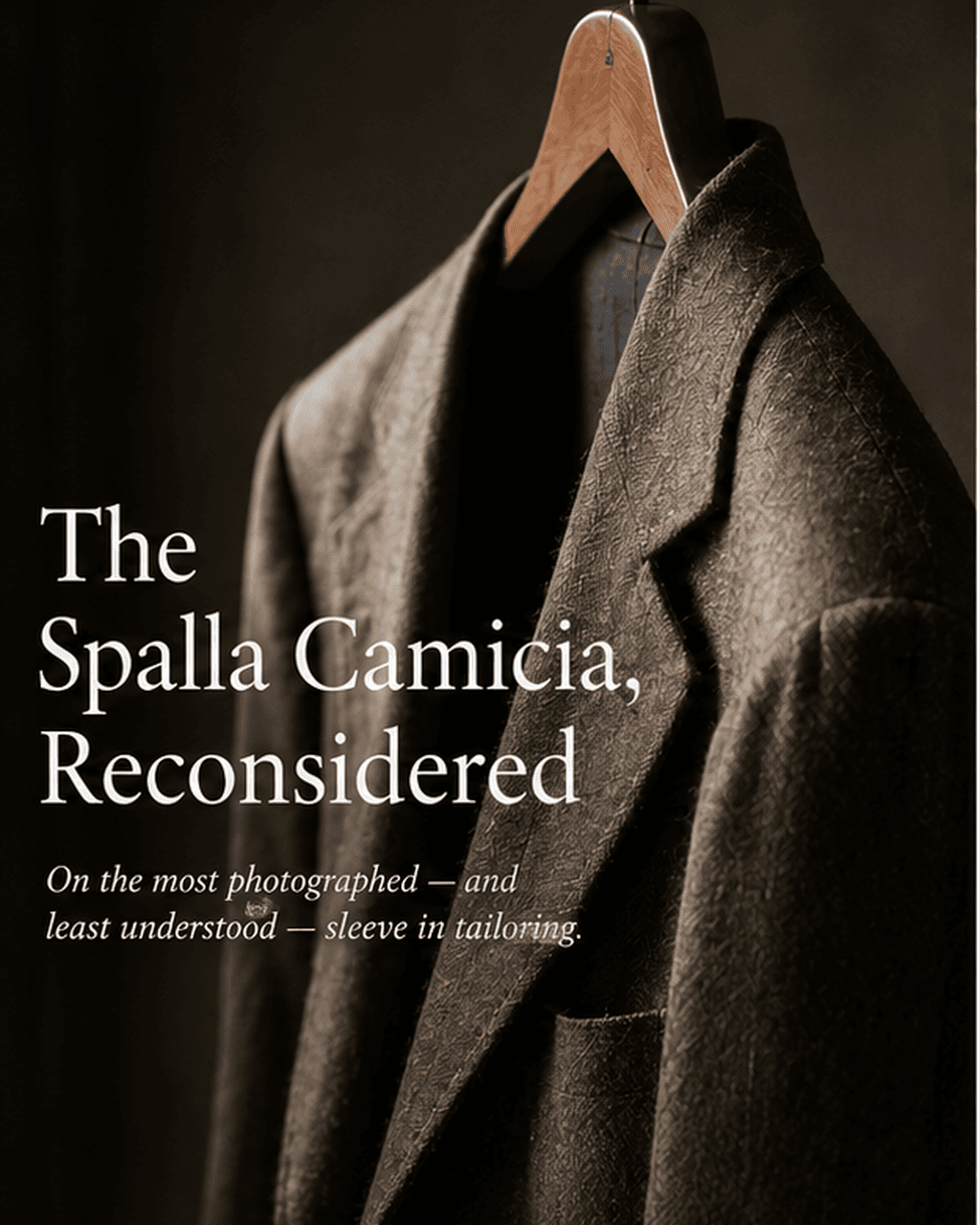
On the most photographed — and least understood — sleeve in tailoring.
There is no detail in modern menswear that has been more enthusiastically photographed, more clumsily imitated, and more thoroughly misunderstood than the Neapolitan shoulder. Scroll through any Pitti Uomo recap and you will see the same shot a thousand times over: a tanned forearm, a sockless ankle, and — between them — a jacket sleeve breaking from the shoulder in soft, rolling ripples, like silk poured down a balustrade.
Most readers, and a surprising number of working tailors, will tell you that those ripples are the spalla camicia. They are not. They are something altogether more interesting, and the distinction tells you almost everything worth knowing about how Neapolitan tailoring actually works.
What follows is an attempt to lay the matter out properly: where this sleeve came from, what it is and what it isn't, why it behaves the way it does in motion, and — perhaps most usefully — who has no business wearing it.
A short prehistory of a quiet rebellion
To understand the Neapolitan sleeve, you have to understand what it was rebelling against.
For the first three decades of the twentieth century, the world's tailoring vocabulary was written, in effect, on Savile Row. The English coat of that era — drape cut, structured chest, layered horsehair canvas, padded shoulder, fully lined — was not a garment so much as a piece of social architecture. It was built for a cold, damp island, a class system that prized composure over comfort, and a body the wearer might not actually possess. Padding could supply the shoulders nature had withheld. Canvas could give a narrow chest a heroic sweep. The English jacket reshaped the man inside it.
In Naples, this was nonsense.
The Mediterranean is not London. Summers there are not warm — they are punishing, humid in a way that turns horsehair canvas into a personal sauna. The Neapolitan aristocracy of the 1920s and 30s wanted to dress like Englishmen but had no interest in suffering like them. The real question was whether the English silhouette could survive the removal of everything that made it English.
The answer came, with some historical irony, from a shop called London House.
It was founded by Gennaro "Bebè" Rubinacci, a wealthy man-about-town and the de facto arbiter of taste among the Neapolitan elite. Rubinacci admired English elegance and had concluded that English construction, in his climate, was absurd. He took the problem to his head cutter, a young man named Vincenzo Attolini. The brief was radical: preserve the outline of the English coat, but strip out everything inside it.
Attolini — trained under Morziello, and quietly studying the soft-curved Roman work of Domenico Caraceni — accepted the commission and performed what amounted to elective surgery on the jacket. Out came the shoulder pads. The canvas was reduced to the thinnest possible interlining, sometimes nearly to nothing. The lining was stripped back. What emerged was what Naples came to call a giacca svuotata — a "hollowed-out" jacket, light enough to fold ten times without effort, draping the body like a second skin rather than standing off it like armour.
With the pad gone, the shoulder had to be reconceived from scratch. The result was a seam that simply followed the wearer's own bone — the spalla camicia, or "shirt shoulder." It was the founding gesture of the Neapolitan school.
A second figure deserves more credit than he usually gets. Giacomo Bruno, who abandoned naval college for the needle, refused to call his establishment a sartoria. He preferred something closer to a boutique of art and fashion. That sounds like marketing now; in context, it was philosophy. Bruno argued that a tailor was not a craftsman fulfilling specifications but an artist expressing a temperament — and that the temperament of Naples was sprezzatura: studied carelessness, the discipline of looking undisciplined. The spalla camicia is the most literal possible expression of that idea. It is enormous labour staged as no labour at all.
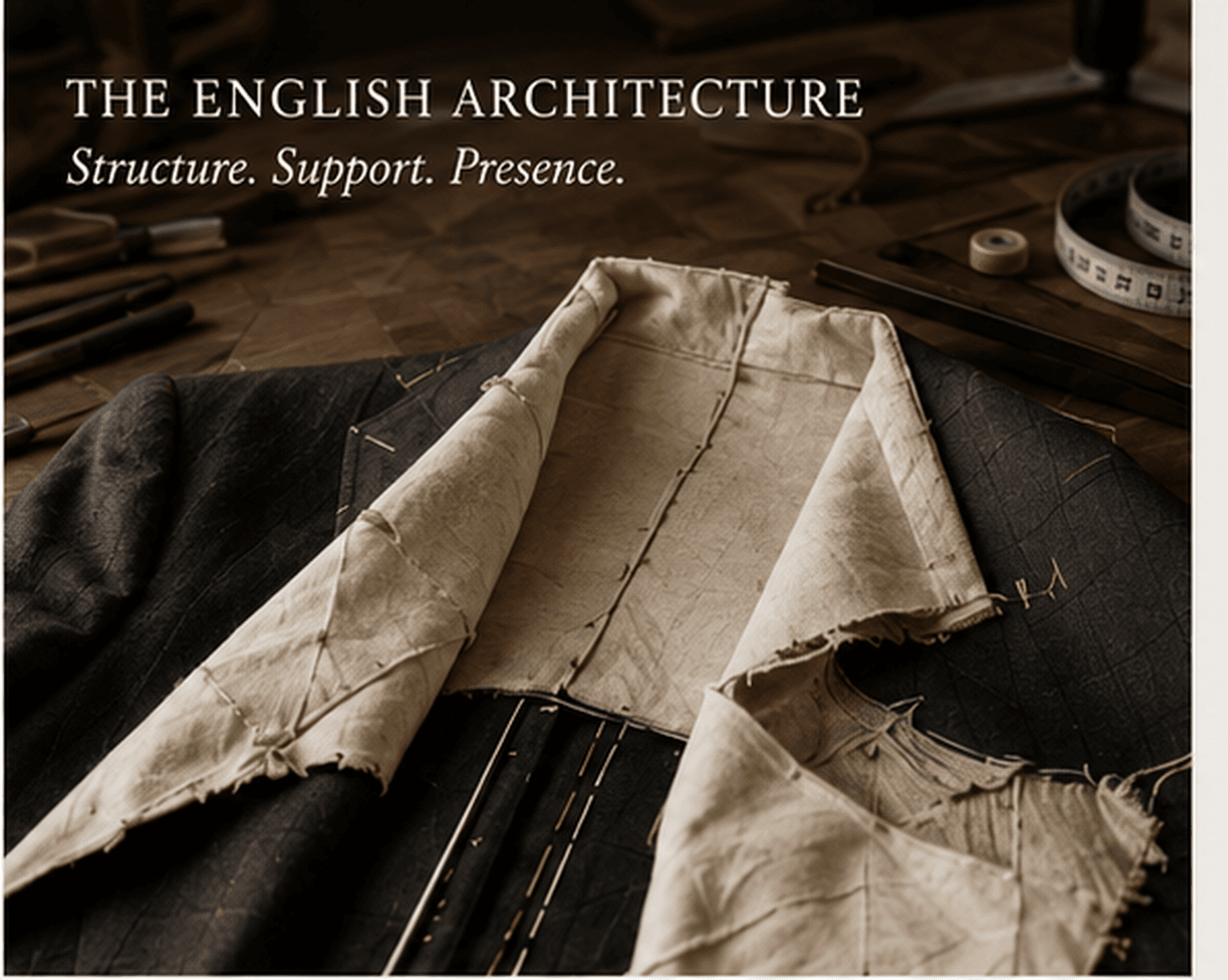

What spalla camicia actually is (and what it isn't)
Now to the central confusion.
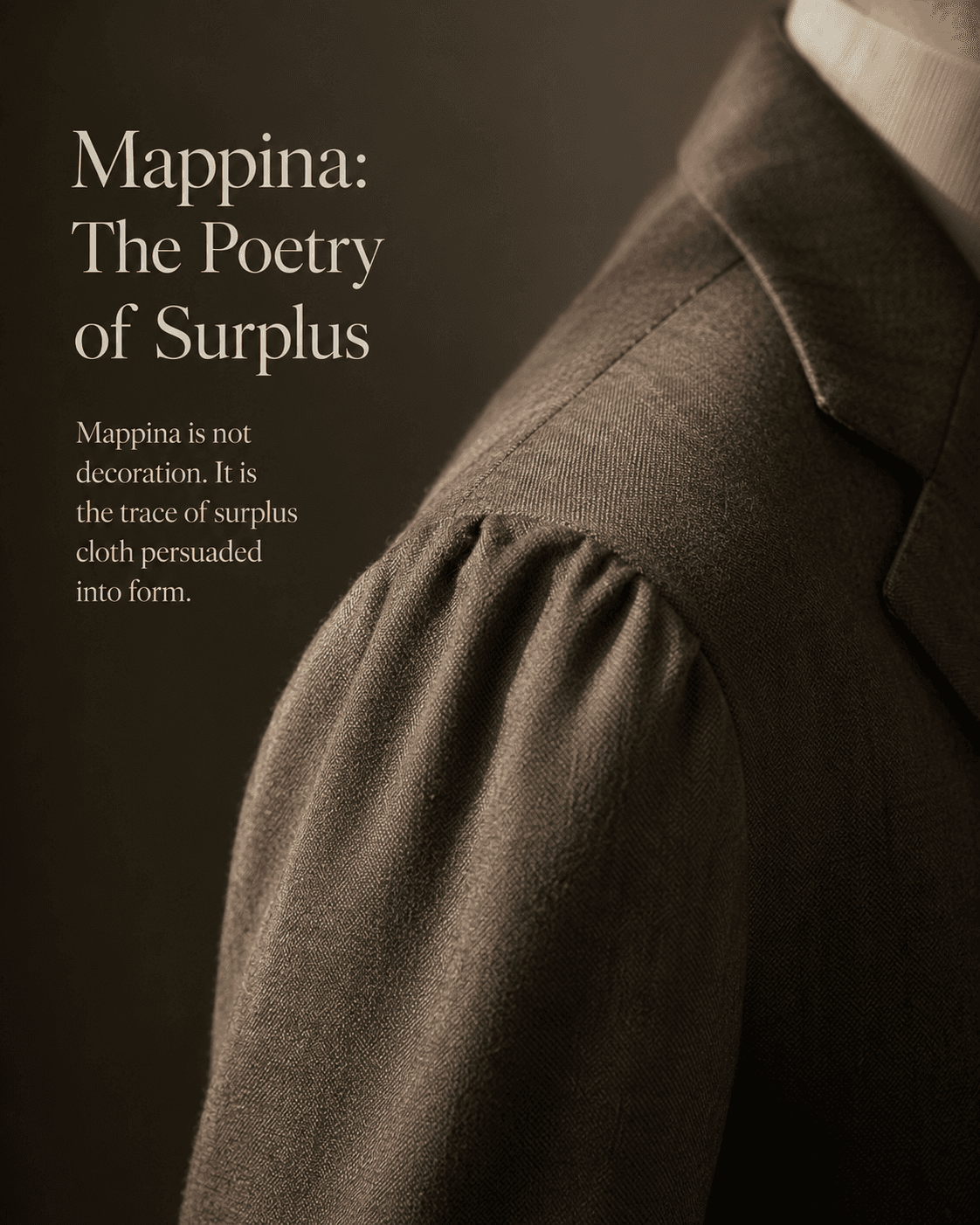
The ripples — those small, breaking pleats marching along the sleevehead — have a name of their own. In Neapolitan dialect they are called mappina, "little rag," or sometimes grinze. They are an aesthetic outcome. They are not the definition of the sleeve.
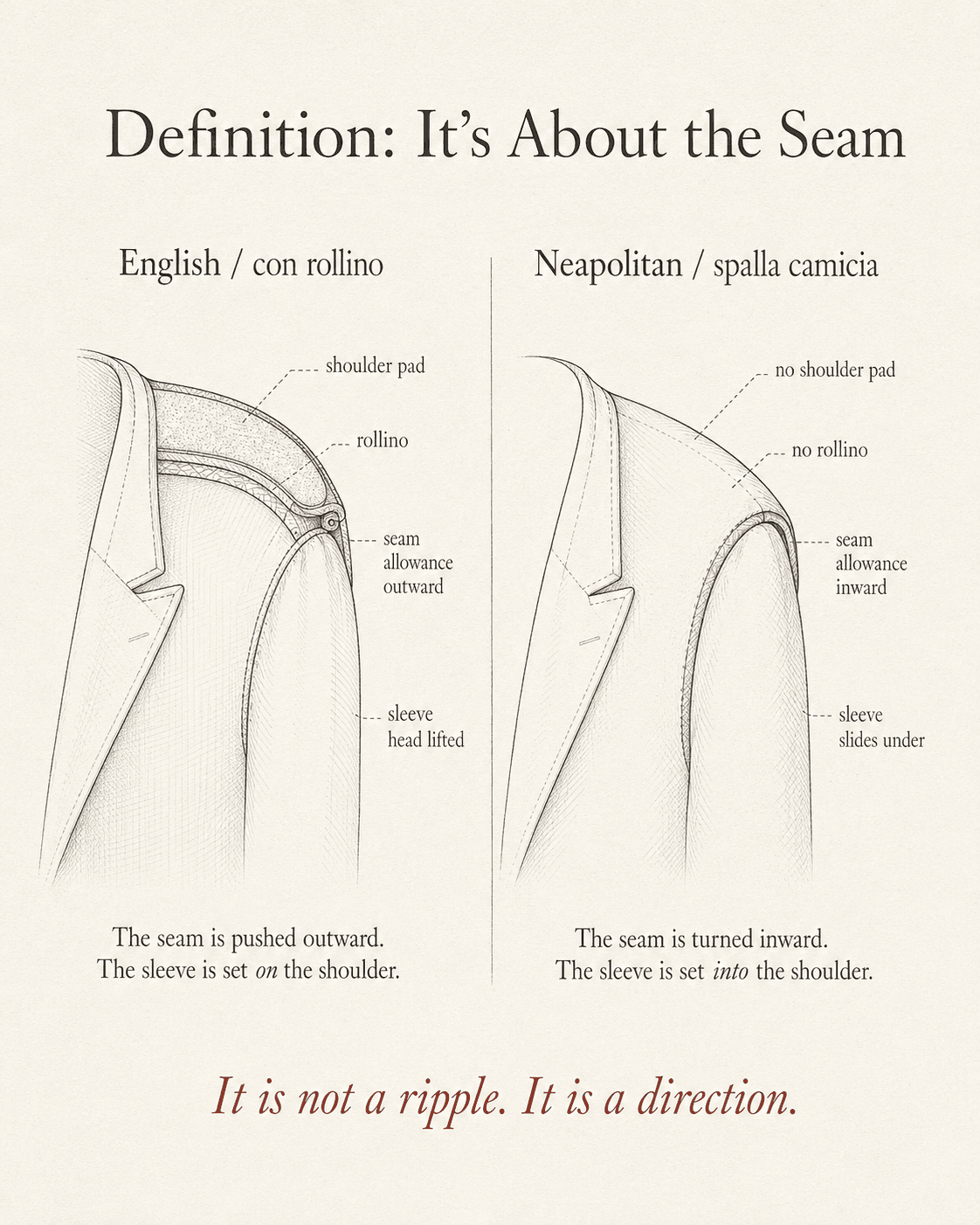
Spalla camicia is a term about seam allowance. Nothing more, nothing less.
In a structured English shoulder, when the sleeve is set into the armhole the seam allowance is pressed outward, toward the sleeve. To support the displaced allowance, the tailor packs in a sleevehead wadding (rollino) — a small crescent of canvas or felt — and, historically, a shoulder pad beneath. The effect is a ridge lifted above the shoulder line: an authoritative, militarily neat little crest. The Italians call this construction con rollino, and it remains the default in Milan and on Savile Row.
The Neapolitan move is to invert the entire logic. The seam allowance is pressed the other way, inward, toward the body of the jacket — the same direction it would go in a shirt, which is why the technique is called giro chiuso (closed armhole) and named after shirting. The sleeve appears to slip under the shoulder rather than perch on top of it. With no rollino, no pad, and no canvas to hold the cap up, the cloth has nothing to do but fall.
That is the entire physical definition. Everything else is consequence, fashion, or marketing.
This is why a perfectly executed spalla camicia can be completely smooth. Serious Neapolitan houses — Caliendo, Ciardi, the older business jackets at Rubinacci — will, on request, press the sleevehead flat for clients who want the soft natural shoulder without the visual jokes. Luca Rubinacci himself has been photographed dozens of times in pinstripe business suits whose shoulders show no rippling at all. They remain, unambiguously, spalla camicia. The seam is still reversed. The construction is still soft. The marketing department has merely been asked to stay quiet.
The corollary matters. A great deal of what is sold as "Neapolitan" in ready-to-wear amounts to faking the mappina without bothering to reverse the seam — printing the surface of Naples onto the bones of Milan. It looks like a duck. It is not a duck.
The geometry of a ripple
So if mappina isn't required, where does it come from when it does appear? The answer is the most beautiful piece of engineering in the Neapolitan repertoire, and it is fundamentally a problem in geometry.
A human arm is not a cylinder hanging from a flat plane. The biceps swells. The shoulder rolls forward at rest. The deltoid sits proud of the rib cage. To set a tube of cloth onto this shape and let it move freely, the sleeve cap — the curved top of the sleeve before it joins the armhole — must contain more length than the armhole into which it is set. The surplus is called ease.
In an ordinary well-made jacket, sleeve cap ease runs to about an inch and a half. In ready-to-wear, the figure is severely constrained: industrial lockstitch can only absorb six to eight percent of the armhole circumference as ease before it begins producing ugly, hard, irregular puckers — the kind that look like mistakes because they are. To compensate, factories drop the armhole — cut it bigger and lower — so the arm has somewhere to go even without proper ease. The price of that compromise we will come to in a moment.
A Neapolitan bespoke tailor proceeds in the opposite direction. He sets out to put as much ease into the sleevehead as the cloth will physically tolerate — ten percent, twelve percent, occasionally more. We are talking about four to six extra centimetres of fabric crammed into a few centimetres of seam. No machine on earth will do this cleanly.
So the work is entirely manual. The tailor bastes the sleeve in with a running stitch, drawing the surplus around the cap by feel, distributing the gathers evenly. Crucially, the upper sleeve has been cut on the bias, which gives the wool a small but vital capacity to stretch and compress along the curve. Then comes the iron: heavy, hot, lavish with steam. Under heat and moisture, the wool's protein structure softens just enough to be reshaped. Most of the gathering is shrunk away — flattened, molecularly persuaded to disappear. What remains, what the iron cannot quite kill, is the mappina.
In other words, those ripples are not decoration. They are a fossil record of the cloth's refusal to be fully tamed. They are evidence that someone tried to fit more sleeve into a smaller hole than physics strictly allows. To the connoisseur, mappina is not a flaw to be tolerated; it is a receipt.
The armhole paradox
That still leaves a puzzle. How does a coat with no shoulder pad, no canvas, and a sleevehead held on by hand stitches manage to give its wearer more freedom of movement than a structured suit? The answer is the giromanica — the armhole — and it is the most counterintuitive thing in Neapolitan tailoring.
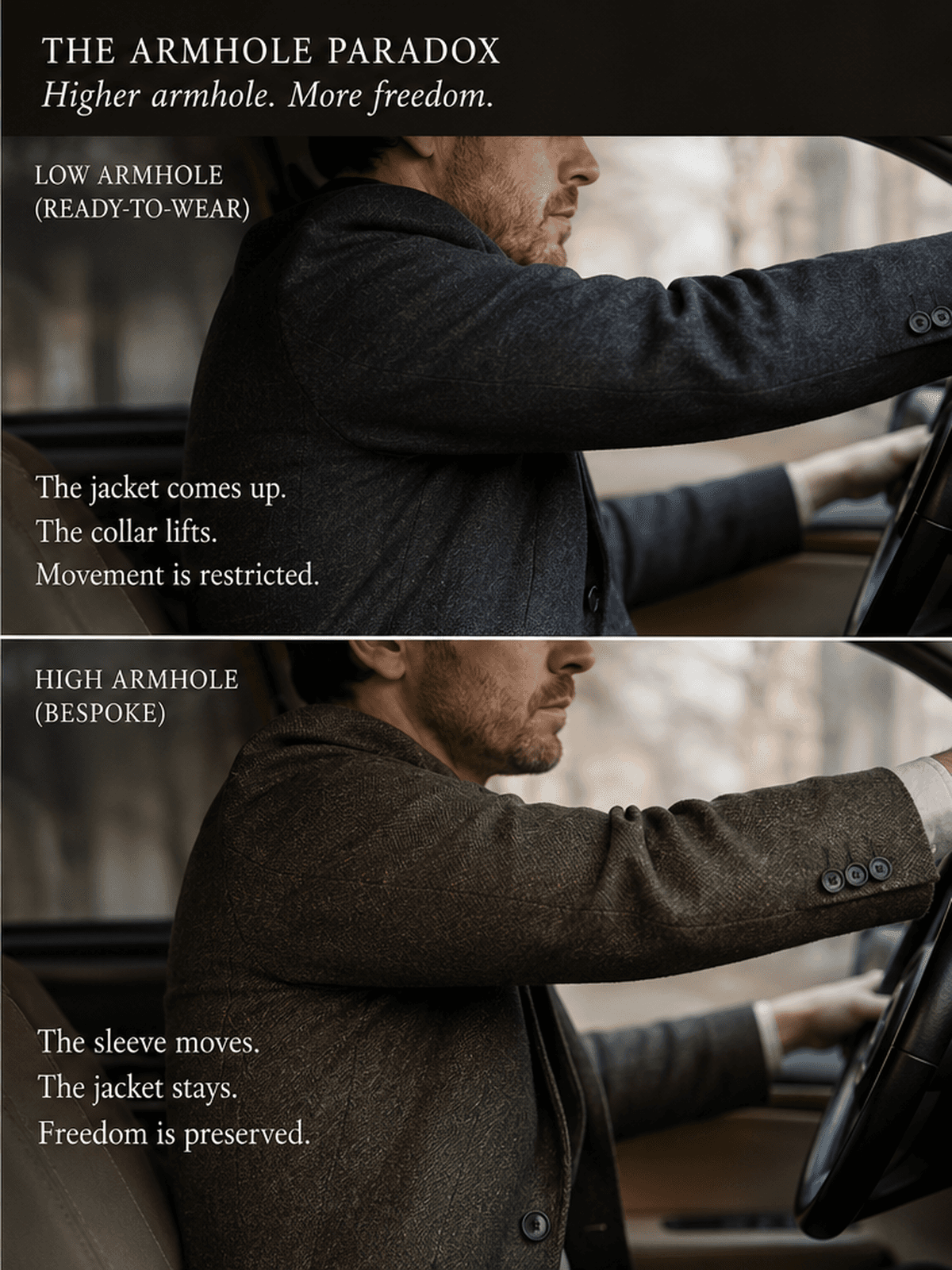
A high, tight armhole gives you a larger range of motion than a low, loose one. Read that again, because it sounds wrong.
The mechanics are about pivot points. The human arm pivots from very high up — essentially the top of the glenohumeral joint, just below the acromion. If the bottom of the jacket armhole sits well below the natural underarm — as factory armholes deliberately do, to accommodate the widest possible variety of bicep sizes — then every time the arm lifts, it must drag the entire base of the armhole upward before the arm itself can rise. That force translates into the side seam, hauls the body of the jacket up the torso, peels the collar off the neck, and produces the unhappy, ratcheted look familiar from any cheap suit on any subway platform.
A bespoke Neapolitan armhole is cut to sit up against the underarm — almost uncomfortably high to a customer who has only known ready-to-wear. From that high pivot, the sleeve moves independently of the body. The arm rises; only the sleeve goes with it; the collar stays on the neck; the chest stays on the chest. Add the soft shoulder and the lavish sleevehead ease, and you have the famous Neapolitan trick: a man can drive a convertible, gesture at dinner, embrace a friend, and the coat stays exactly where it was put. Like a second skin is not a metaphor here. It is geometry.
The cruelty of an honest sleeve
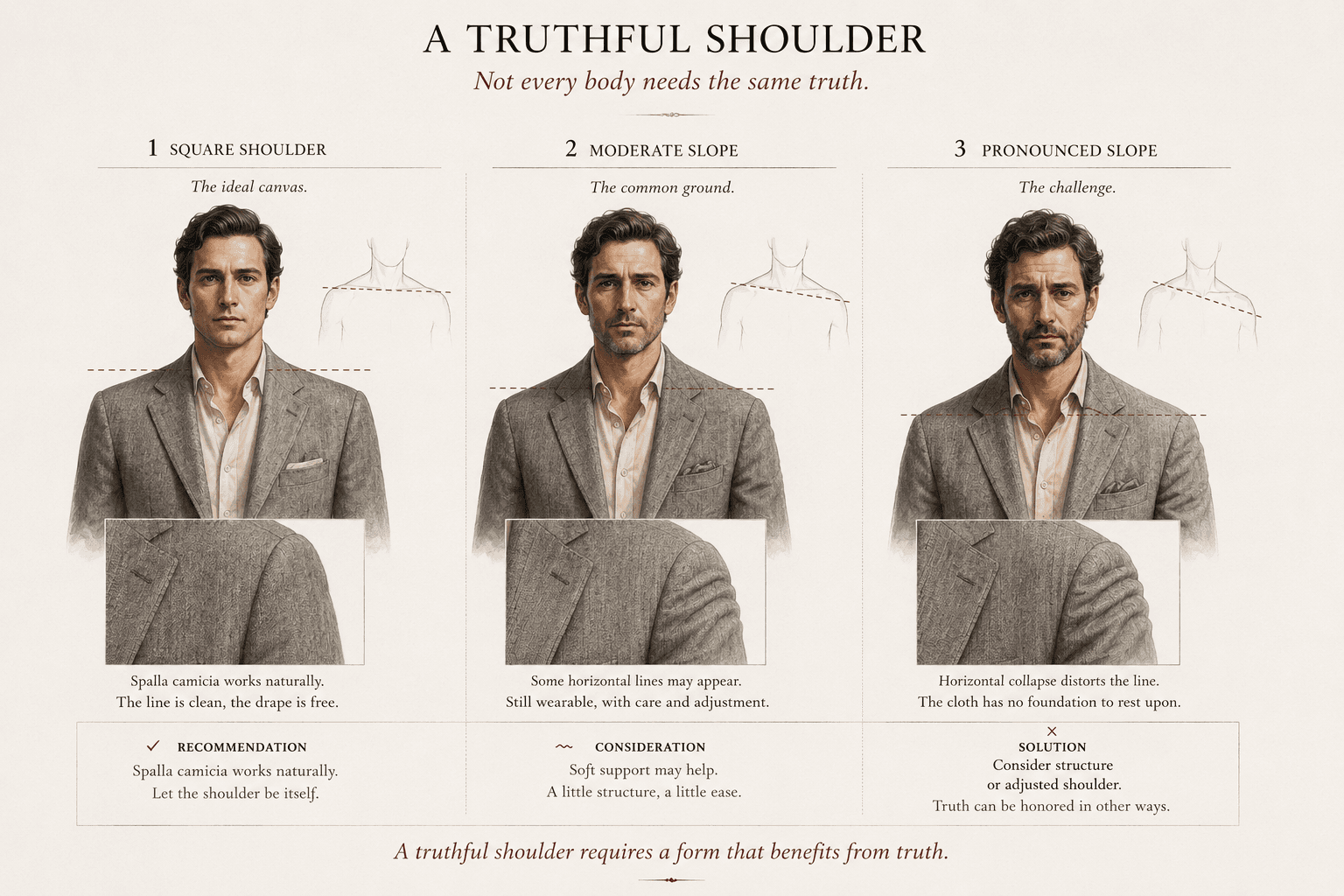
The romance writes itself. Sleeves like falling water, jackets like silk, freedom of movement, sprezzatura. What the romance leaves out is that an unstructured shoulder is, in the most literal sense, a truthful shoulder — and not every shoulder benefits from the truth.
Strip away the pad, the canvas, the rollino, and you are left with the wearer's actual skeleton. For a man with square or slightly built-up shoulders, the spalla camicia does what it promises: it traces a relaxed, natural line that flatters him precisely because it is his. For a man with markedly sloping shoulders, it can be a quiet disaster. Without internal scaffolding to lift the line, the cloth simply pours down the slope. The shoulders look narrower than they are. Worst of all, horizontal creases collect in the triangle between shoulder and chest — not the elegant cascade of mappina, but a structural collapse, the cloth giving up because there is nothing inside it to hold the form.
The irony at the heart of the Neapolitan ideal is this: a style that prides itself on naturalness requires its wearer's natural form to be photogenic to begin with. A heavily structured Milanese coat or a properly built Savile Row drape can rewrite a difficult shoulder. The Neapolitan jacket does no such thing. It tells the truth.
The most responsible Neapolitan houses know this. A senior cutter at a serious sartoria, faced with a customer whose shoulders fall away sharply, will quietly add a whisper of internal support, reset the sleeve pitch, or — more honestly still — suggest the customer consider another silhouette altogether. The fashion press rarely reports this part.
Naples in context: a comparative anatomy
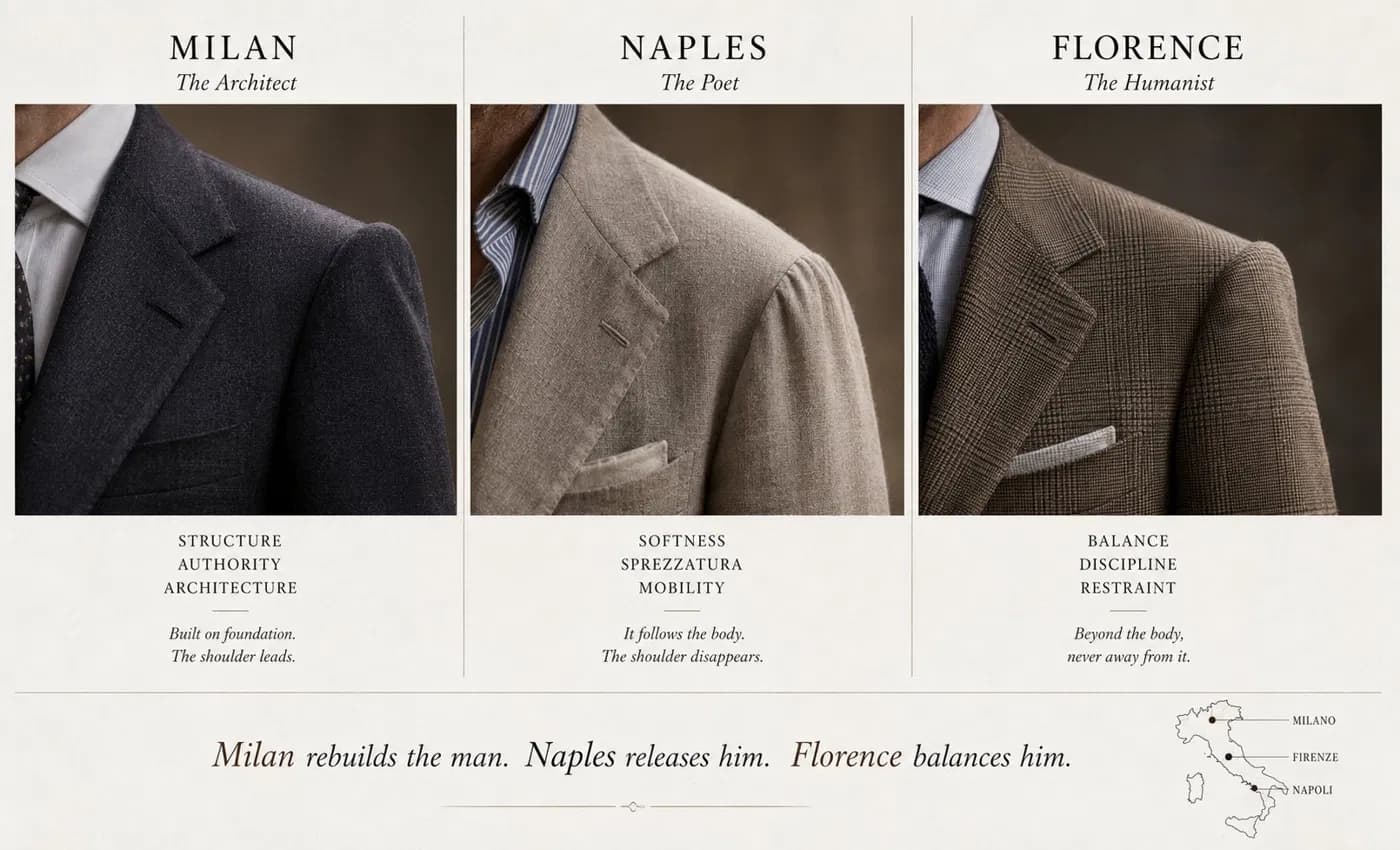
The spalla camicia only makes sense against its alternatives. Italy's three great tailoring traditions — Milanese, Neapolitan, Florentine — are not regional accents of one language. They are different languages with overlapping vocabularies, and the shoulder is where they diverge most sharply.
Milan descends from industrial wealth and Lombard discipline. The coat is structured, with a moderate but real shoulder pad (spallina), a full canvas chest, a strong forward dart, and a rollino sleevehead that lifts the line into a clean, almost architectural ridge. The Milanese jacket is the uniform of bankers and industrialists, of the men who built skyscrapers. Its job is to declare authority, and it does so by making the wearer's body slightly more impressive than it is. The garment speaks first.
Naples, as we have seen, is everything Milan is not: hollowed out, soft, draped to the bone, the shoulder following the body rather than redrawing it. The chest is barely interlined. The front dart, where it exists, is often exaggerated — sometimes run all the way through the patch pocket and out at the bottom hem, an outright provocation. The coat does not declare; it relaxes. It says: I am here. You may join me.
Florence, which receives less ink than either, sits between them with deliberation. Liverano & Liverano is the canonical case: an unpadded shoulder, but one ironed and shaped with such severity that it appears nearly crisp; a shoulder line extended very slightly past the wearer's natural bone; full canvas, but used to mould the waist through ironing rather than aggressive cutting; and — here is the wonderful provocation — no front dart at all. The dart is moved to a vertical line tucked behind the side seam, because a front dart breaks the pattern of a glen check or windowpane, and the Florentines find that unforgivable.
One more Florentine detail deserves attention, because it speaks directly to our subject. The senior people at Liverano take the view that mappina on a tailored jacket is too informal — a touch vulgar on a serious garment. Their jacket sleevehead is pressed smooth. The sprezzatura, in their philosophy, belongs on the shirt underneath. This is the discipline that separates a school from a tic: knowing when not to do the thing you are famous for.
To put it as compactly as possible: Milan rebuilds the man, Naples releases him, Florence balances him.
Why the sleeve is never alone
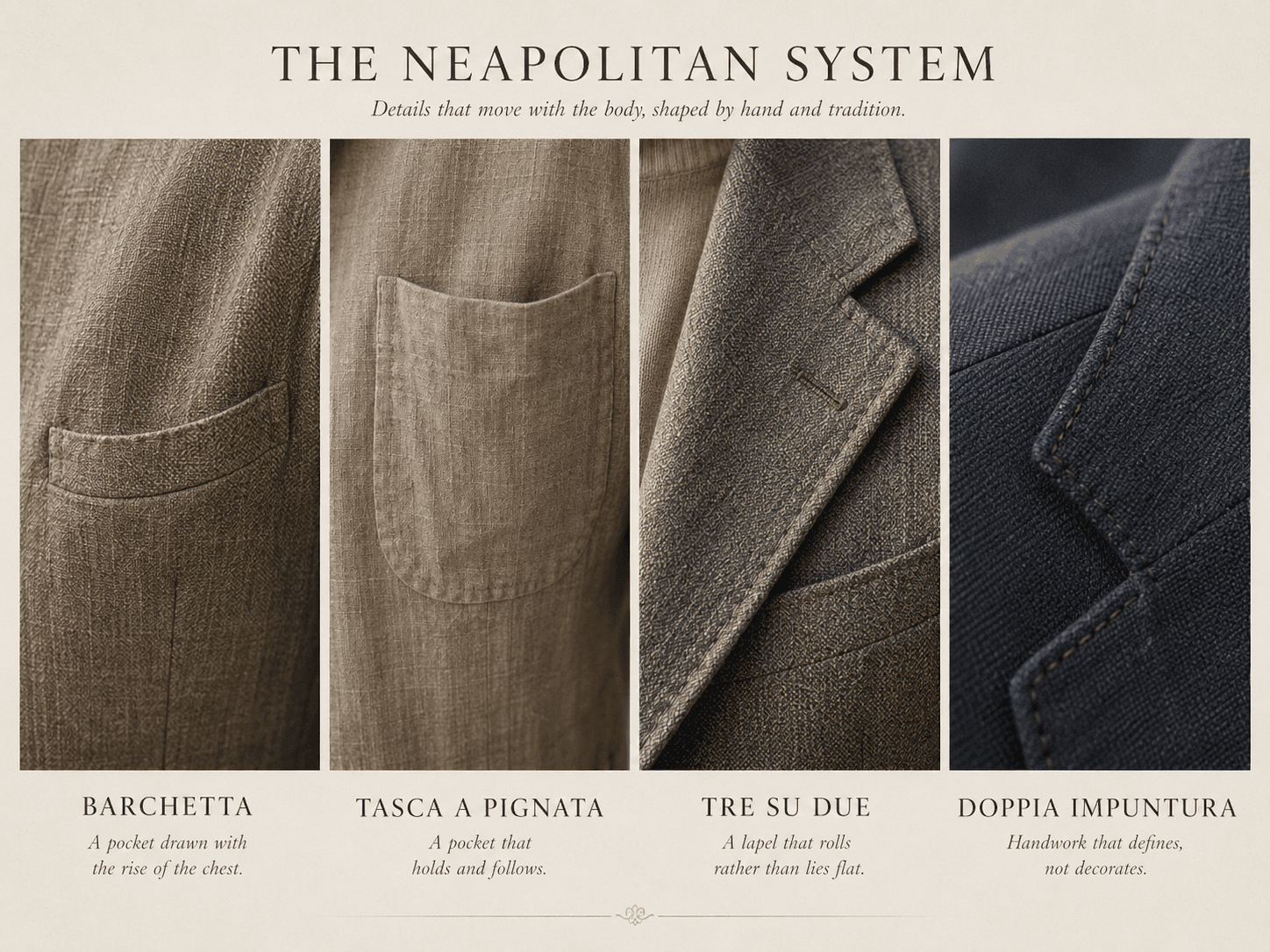
A common error in ready-to-wear is to graft a spalla camicia onto a coat otherwise structured along Milanese or Anglo lines and call the resulting Frankenstein "Neapolitan." It is not, because the Neapolitan jacket is a system. The sleeve is one note in a chord. To hear the chord, you need at least four others.
The barchetta, or "little boat" chest pocket. Where the English welt pocket is a ruled straight line set against the chest, the Neapolitan pocket is cut with a gentle upward curve — like the hull of a small boat seen from the side — following the natural rise of the pectoral. It cannot be done cleanly by machine. It can only be cut and pressed by hand, and it gives the chest the same liquid mobility the sleeve gives the shoulder.
The patch pocket, locally tasca a pignata — "stewpot pocket" — rounded at the bottom, slightly pinched at the mouth, the silhouette of an inverted brandy snifter. It is the natural lower-body partner to a soft shoulder: a pocket that has given up any pretense of formality and embraced the holiday in everything.
The tre su due — three buttons rolling to two — a front that appears to carry three buttonholes but in which the top buttonhole is concealed inside the natural roll of the lapel, often sewn upside-down because it is never meant to be fastened. The effect is a three-dimensional, slightly bellied lapel that catches light along its roll, the opposite of the flat pressed lapel of factory tailoring. Visually it answers the soft shoulder by giving the chest its own gentle topography.
The doppia impuntura, the visible double row of pick stitching along the lapel edge, pocket mouths, and seams. In Savile Row's lexicon, visible stitching is a structural concession to be minimised. In Naples, it is a signature: this was made by a human being, and the human being would like you to notice.
These elements form a single coherent statement. The spalla camicia without the rest is a costume. The rest without the spalla camicia is a different coat altogether.
The micro-spring: why hand stitching matters here more than anywhere else
We can close where the craft itself closes — at the needle.
A modern factory lockstitch is a wonder of engineering and the wrong tool for this job. It interlocks the upper thread with a bobbin thread mid-fabric in a knot that is essentially immovable. Excellent for strength. Useless for give. When a factory tries to push twelve percent ease into a sleevehead by lockstitch, the resulting puckers are dead — locked in by thread that will not yield. Lift the arm and the seam refuses to deform with the muscle. The cloth resists. The shoulder pulls. You feel the suit fighting you.
A bespoke Neapolitan sleevehead is set by punto indietro — a backstitch worked with waxed silk thread, the needle advancing one stitch and returning half. The thread loops on itself inside the cloth rather than locking flat. Because no human hand applies precisely equal tension to two consecutive stitches, the resulting seam has microscopic, irregular elasticity built into its very geometry. The seam becomes, in effect, a tiny chain of springs.
This is the part that no machine reproduces. When the wearer rolls his shoulder, the silk in the seam gives — stretches a fraction of a millimetre, absorbs the load, lets the wool around it slide and ease. When the arm returns to rest, the silk recovers, pulling the gathers back into their pressed position. The shoulder doesn't crumple over the course of a day, because the seam is doing the work the structure is no longer there to do. The mappina is not a static visual; it is a working mechanical element that breathes with the body.
This is what people are really paying for when they pay for hand-set sleeves, and it is why a five-thousand-dollar machine-made "Neapolitan" jacket and a five-thousand-dollar bespoke one are not the same garment with different markups. They are different objects.
A closing thought
It is tempting, after all of this, to treat the spalla camicia as arcane technical trivia — a sleeve for collectors. That would be a mistake.
What Naples produced, in the years between Rubinacci's commission to Attolini and the post-war revival, was not really a new sleeve. It was an argument about clothing itself: that a coat should not impose a body on a man; that comfort and elegance are not opposed but allied; that the highest craft is the kind that disappears against the wearer. The waterfall sleeve is the cleanest expression we have of that argument. Twelve percent of surplus cloth, persuaded with steam and silk into a high, tight armhole, so that the man inside can drive, gesture, embrace, sweat through a Neapolitan August, and forget — completely forget — that he is wearing anything at all.
That is the trick, and it is not a small one. Behind every effortless thing worth wearing is a quite extraordinary amount of effort. The Neapolitan sleeve simply has the grace not to mention it.
Atelier Saison
Bring the question to a fitting
The useful lesson is not to copy Naples, but to understand proportionate softness: a shoulder can be light without being weak, a sleeve can move without looking loose, and a jacket can hold presence without becoming rigid.
真正值得带回试身间的是“有分寸的柔软”:肩可以轻,但不能弱;袖子可以有行动余量,但不能散;衣服可以有气场,但不必僵硬。